An Interview with Nana Visitor

Nana Visitor is many things. Of course, we know her best as an actor for her work as Major Kira in Star Trek: Deep Space Nine, but she is also a thinker, some might say a survivor, and now she’s a debut author as well. With the release of her recent book Open A Channel: A Woman’s Trek, Visitor sat down with Warp Factor Trek to discuss the book and all that went into writing it.
Open A Channel
The book is a serious discussion of the women of Star Trek, throughout the various series and both onscreen and behind the scenes. It might have started as an upbeat, positive look at how the series has bolstered women ever since Nichelle Nichols first appeared on the bridge of the USS Enterprise, but it quickly became so much more in Visitor’s hands. It speaks to watching a universe set in the far future and – sometimes – not seeing the enlightened future we hope to see.
“What’s interesting to me is this span of time [that Star Trek has been on],” she says. “What else in popular culture can you look at the progress and what women went through? And all these women knowing each other for the most part. They’re very distinct, different voices, as are the people who created these characters. Every time I did an interview, I found that I needed to educate myself.”
For example, she notes, she spoke with a group of prominent Hollywood women who, in the 1960s, guest-starred on The Original Series. “I didn’t really understand what the cultural pressures were at that time,” she admits. “I had to stop and educate myself about that, and then I’d have to stop and educate myself about something else, and as I went on, it all just got woven into the book. I am so grateful to [Editor] Ben Robinson, for allowing me not to make this a fluff piece. He could have said, ‘No, no, pull it back,’ and CBS read every word I wrote and let it all go in. They did not censor me at all.”
Seeing Star Trek in a Whole New Way
I, for one, am glad that Visitor wasn’t censored or told to pull back in her writing. She looks at Star Trek in such a unique, distinct way that, since reading Open A Channel, I’ve gone back and watched episodes I’ve seen many times over and saw them in a different, more critical way. This book taught me something new about my favorite show.
“It’s interesting to put different lenses on it and see, okay this was Star Trek, and this was the culture it was in,” she says. “Those are two different things. And I never forget that we were all caught in the culture of our times at different times. If we can look with affection and constantly reassess, and say this part is valuable and that part we can let go of, I think that’s progress. Not throw the baby out with the bathwater, but compassionately look back, with the information we have now, and say, ‘Oh, I see where that came from.’”
That compassion Visitor speaks of is present throughout her book. This isn’t a discussion about everything Star Trek got wrong in its portrayal of women. On the contrary, it’s an examination of how – over the evolution of the franchise – the show kept getting more and more things right.
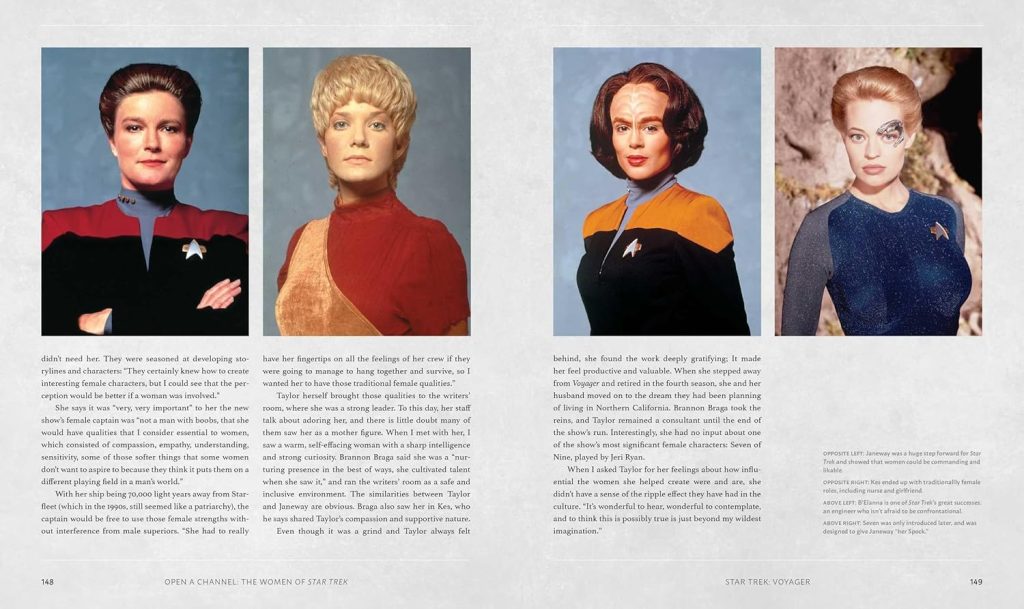
One example she notes in the book is the Star Trek: Voyager episode “Blood Fever”. B’Elanna Torres is in the throes of pon farr and, sex-crazed, she is stranded with Tom Paris on a planet’s surface. When Paris refuses her increasingly adamant advances, Visitor writes: “It’s a scene that could be used in schools to show how to honor the whole woman by wanting both her body and her mind, and that someone out of control isn’t in a position to give consent.”
“I spoke to so many viewers,” she tells me, “where I heard over and over again how important B’Elanna was. Because she was biracial. Because she had anger issues. Because she was a woman, and an engineer, and great at her job. There were so many aspects that spoke to people. You start seeing it when you’re told what that means.”
She’s a Trekkie!
Over the two to three years that she worked on the book – conducting interviews (mainly over Zoom) with the lead female actors who played in each series – Visitor also watched Star Trek. A lot of Star Trek. And if you are as enamored as I am by the idea of Nana Visitor sitting on her couch and binge-watching Star Trek, you will be happy to know that she calls herself a fan. Even though she was watching for research, she says she sometimes kept going until she was bleary-eyed because she simply got caught up in the stories.
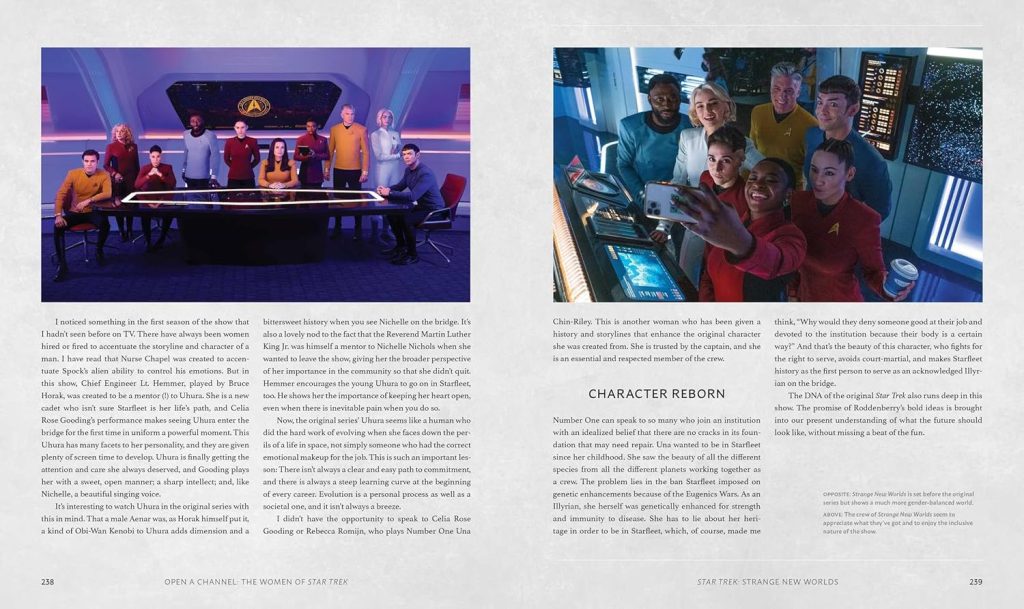
“I’d get on something with Seven of Nine,” she says, “and I’d have to see the whole arc. I’ve got to keep going. I became a fan of all these shows! I was so impressed with what they’ve done. One of the shocks to me, having never watched Voyager, was how much depth and breadth there was. I had these impressions, and most of them were wrong. To watch this show and appreciate these characters was amazing… and Strange New Worlds? I love that show!”
Visitor also re-watched episodes of Deep Space Nine with that same critical eye and is quick to say how grateful she is that her character was given such a detailed and full arc. We knew a lot about Kira Nerys and, Visitor observes, it’s because she was “written that way.” Says Visitor, “If Kira says hello to a Cardassian, you know what that means, because you know her past and you knew what led up to that moment.”
Other female characters of Star Trek, she notes, weren’t nearly as lucky. One example she writes about in the book is Counsellor Troi (Marina Sirtis) on Star Trek: The Next Generation. Even though she was an empath and could sense the emotions of those around her, the audience doesn’t get a lot of chances to know anything important about her. “We knew she liked chocolate,” Visitor says, “and she had an overbearing mother.”
She also laments in her book that, in all her interviews with fans, no one ever told her that any of the female characters of Star Trek: Enterprise were particularly inspirational. After the book was published, however, an engineer she interviewed did tell her that T’Pol was an influence. “And yet,” she says, “I still want that scene where Linda Park [as Hoshi] says, ‘Hey, I am an expert at my job. Why are you questioning me? What is going on with the dynamic with all these men?’”
On Her Personal Trauma
Many of us know about Nana Visitor’s personal, real-life trauma of being kidnapped and raped during the time she was filming Deep Space Nine. She first spoke about it a few years ago, on a podcast hosted by Gates McFadden (Dr. Crusher). In the book, however, she writes about it in much greater detail. It’s a chilling description. I asked her if it was more difficult to put those details into writing than it had been to talk about it.
“In a way, it was,” she replies, “because it was a longer period of time to stay in those memories. But I’ve done a lot of work, so I own those memories. It’s my story. The days I was writing that were emotionally difficult, but the shame of these things has to go away. And the silence – especially between women – has to go away. Also, the knowledge that, really, what happened to me when I finally did start to work on it and deal with it… is that post traumatic recovery is a thing. And people can benefit just from hearing about that. The work that I did on myself? There’s no question that I am a more complex, more compassionate person now than I ever was before the incident. It’s so important, that communication, that I always will speak of it.”
When I first learned about what happened to Visitor, I went back and rewatched several episodes of Deep Space Nine and saw her character in a new and deeper way. I asked her if the post-traumatic stress from the incident informed the way she played Kira.
“I didn’t have the name for it then,” she says. “But I knew that was the experience for people that had experienced war came with. It was fascinating to me to later take a deep dive in learning what [PTSD] was about and then look back and see it was textbook for Kira. The anger, the fear, the flashbacks, all of it was textbook.”
She also says she better understood the complex emotional landscape of her character after the fact.
“There’s a scene in the sixth or seventh season,” she says, “where there’s a dynamic of danger between four or five of us. I remember it being so important to me that it be chaotic. That kind of violence is chaotic, and everyone, to some degree, is scared. That was a lesson that I learned. It’s not all bravado. Underneath the bravado, everyone is scared.”
What’s Missing from the Book (and Where to Find It)
When asked about the initial reaction to her book from fellow Star Trek alumni, Visitor says that perhaps the biggest issue people have is that not every woman is included, because there simply wasn’t room. She has, however, provided some of this content in the form of Instagram videos (@nanaopenchannel).
“One huge example is Michelle Hurd [Raffi on Star Trek: Picard]. She’s not in the book, but she is, I think, who Nichelle Nichols would say, ‘Yes, that’s who we need.’ I think that Ms. Hurd is the same kind of activist [as Nichols],” Visitor reckons. “I look to Star Trek, as so many of us do, to say, ‘What’s next? What should we be working on next?’ And what [Hurd’s character] answered was veterans. And how we treat people with addiction. And just understanding the dynamic of a woman who worked and had a child and did the best she could. And what the dynamic is between an adult child and a woman. I thought that was really something for women that we haven’t examined.”
She also agrees that the character of Raffi was highly instrumental in informing the rest of Seven of Nine’s story arc, and it made me wonder: if Visitor had been invited to join Star Trek: Picard and revive her character, what would Major Kira be up to now?
“I like the version that she is still on the station,” she says, “that she is running it, and that she has a very close mentorship relationship with Jake [Sisko]. If she has adventures, you know, that’s great! But I still see her on the station.”
