Open a Channel: A Woman’s Trek in Review

When I was asked to review Nana Visitor’s forthcoming book Open a Channel: The Women of Star Trek, I jumped at the chance. Not only did she play one of my favorite Star Trek characters (Major Kira in Deep Space Nine), but Nana herself is one of my favorite actors in the franchise and continues to captivate me with what she’s offered of herself since.
This book is, in a word, impressive. It is a serious and detailed dive into every female character in every Star Trek series. But it’s so much more than an encyclopedic listing on the topic.
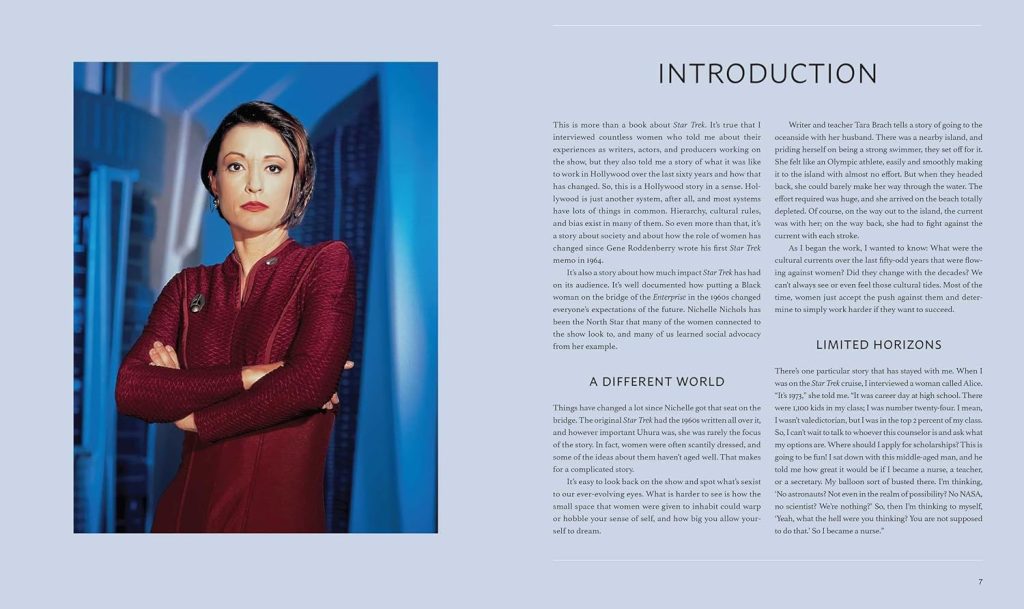
Nana views the women of Star Trek through several lenses at once: a feminist lens, a cultural lens, and an historical lens. Through research and conversations, she discusses the characters – and the actors who played them – in the context not only of the show, but the time in which each series was produced. She speaks to the real advances Star Trek has forged for women since the original series aired in the 1960s, but she also addresses the problems, the limitations, and the obstacles women (particularly women in Hollywood) have historically faced. She calls it “swimming against the current.”
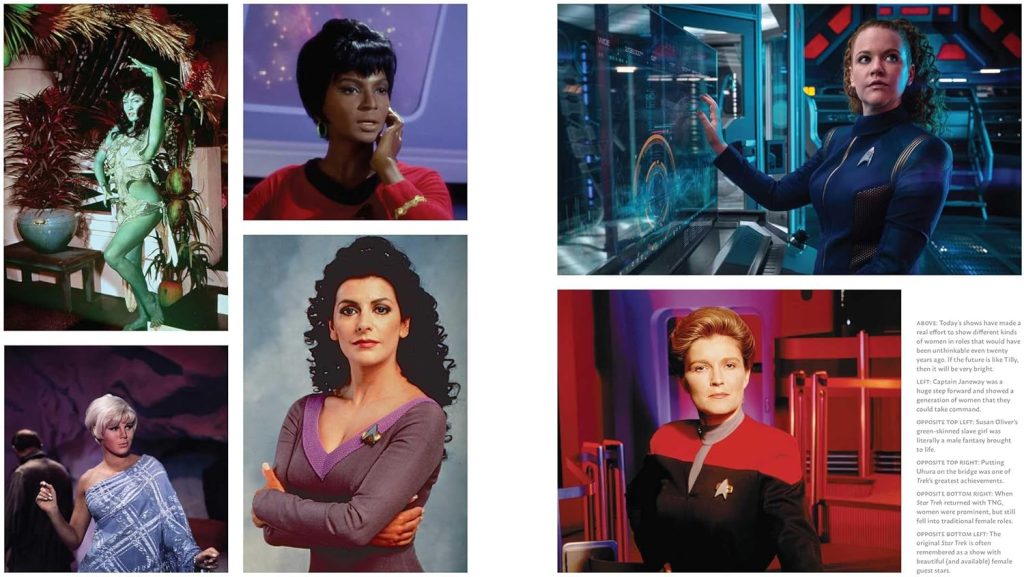
For example, we all understand the huge importance of Gene Roddenberry’s decision to put Nichelle Nichols on the bridge of the Enterprise in the 1960s, but the book also recounts that Majel Barrett-Roddenberry was ousted as that show’s Number One and replaced with a male first officer. Although the role was literally written specifically for her, she ended up playing the culturally “safer” role of Nurse Chapel. Better optics for the time.
Hits and Misses
As she advances through each Star Trek series, Nana holds a light to the many positive changes in the portrayal of the female characters – all of those steps forward – as well as the missed opportunities and, in some cases, the steps backward. (Looking at you, Enterprise!)
Even though Star Trek: The Next Generation features a woman as Chief Medical Officer (Gates McFadden as Beverly Crusher), we see almost nothing of the character’s other, very significant role: a single mother of a young man. The book notes that McFadden herself argued that her character should have more meaningful on-screen conversations with her son but that, inevitably, “one of the male characters would get that scene.”
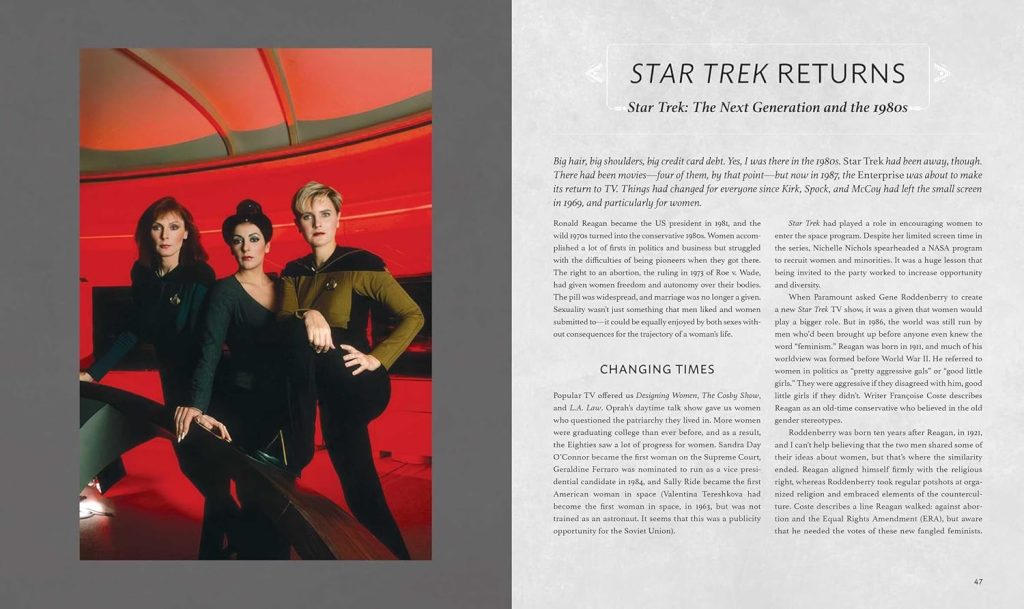
One of my favorite discussions in this book concerns Marina Sirtis in her role as Counselor Troi. Although Sirtis was one of the few actors who declined to be interviewed for the book, Nana does a truly remarkable job of examining the character and pointing out various problems in how she was depicted at the time. She was, Nana feels, almost entirely viewed from a male perspective, not only in terms of her undeniable beauty, but in the character’s experiences as well. “In rewatching episodes,” she writes, “I was struck by how many times Troi’s body or brain was used against her will.” She couples this observation with the notion that – despite the fact that Troi is an empath who can sense the emotions of those around her – the audience rarely gets a sense of her own emotional landscape.
One example: in the episode “The Child”, Troi is essentially raped by an alien entity who wishes to experience physical birth and life. By the time this fast-growing child decides to sacrifice its physical form to save the ship and crew, Troi has come to honestly love it as her own and is distressed at its leaving. But a few minutes later, before any full examination of the character’s emotions, she quite happily joins the crew on the bridge and the episode ends with some banal reference to Wesley Crusher. Nana, quite rightly, notes that the episode was a “missed opportunity” to address “issues that humans deal with in the present day: assault, permission, sovereignty of one’s own body, and the aftereffects of loss.”
Major Kira and personal reflection
When she writes about playing Major Kira on Star Trek: Deep Space Nine, Nana notes that her character was given the gift of a full and, importantly, evolving story arc over those seven years, unlike so many of the female characters that came before her. Not only was Kira a strong and physically capable female with agency and grit, but she was also a complex and deep person. She had rich and fully developed personal relationships – romantic and otherwise. She questioned her own bias toward Cardassians and grew enough to be able to work effectively with her enemies. Most importantly, though, she overcame serious post-traumatic stress from growing up under Cardassian rule.
To this last point, Nana Visitor knows a thing or two about PTSD. While filming the third season of the series, she was brutally and horrifically kidnapped and raped. She writes about this with courage, clarity, and an honesty I find truly extraordinary. I didn’t know this about her until years after the series ended. But when I rewatch it, I am struck by how that experience must have colored her portrayal of Kira. I see strength, but also an openness in the character. Above all, I sense a kind of quiet wisdom in her. I imagine that’s how Nana must have approached Kira back then, although she admits she struggled with PTSD for nearly twenty years. I like to imagine that the qualities she imbued in Kira helped her in that struggle.
Conclusion

Any impression that this book is purely an examination of hurdles, obstacles, and missed opportunities for women in Star Trek would be wrong. Nana writes about the galactic strides and successes the franchise continues to afford women and gender-non-conforming people who were once relegated to the sidelines. In essence, the book is a discussion of where we are and how we got here, told through a Star Trek lens. And it’s the discussion that’s so important. Open a channel, indeed.
