Star Trek at Sixty: The Arduous but Optimistic Struggle for Peace

“Space can be explored and mastered without feeding the fires of war, without repeating the mistakes that man has made in extending his writ around this globe of ours! There is no strife, no prejudice, no national conflict in outer space, as yet. Its hazards are hostile to us all! Its conquest deserves the best of all mankind! And its opportunity for peaceful cooperation may never come again!”
It was not “The Great Bird of the Galaxy” who uttered those words nor William Shatner. It was not any character named Zefram Cochrane or Jonathan Archer. It was President John F. Kennedy, announcing his challenge to “go to the Moon” at Rice University in 1962, two years before the first Star Trek pilot, “The Cage”, was penned. Kennedy would never live to see Star Trek of any kind or that successful trip to the moon.

In the nascent days of this franchise – sixty years ago this week – assassinations, riots, protests, wars, and the threat of nuclear annihilation ruled the globe. Another world war seemed inevitable. Science fiction started asking questions about where the Industrial Revolution might lead us – the potential for destruction. Philosophers mused about the superficiality of it all. Scientists pondered their place in morality.
Enter Star Trek.

Now, there’s plenty of places to find hope and inspiration. There’s religion and philosophy, life experiences, and people in our lives. Cat and dog videos can relax us. TikTok and memes can even be truthful. Still – in the time of the 1960s,especially in science fiction – this optimism was revolutionary. It remains even moreso today.
Star Trek said we’ll endure World War III… and survive. The world will unite under a banner of peace and invention, as warp drive will end poverty, war, and disease after the Eugenics Wars. We’ll use all the potential resources of war to build great starships and explore the galaxy. Nuclear bombs will seem arcane. The only acceptable war will be a defensive one.

We’ll need defenses against the Gary Mitchells and the Klingons, Q and the Borg, the Dominion, the Xindi, the Cardassians, and the Romulans. But we’ll survive… and thrive.
That’s what’s different about this science fiction franchise. No matter where and when we are – on Earth or a much more distant location, from the year 2063 to the 32nd century – humanity will still have that innate spark that keeps us flickering. In TNG’s “The Best of Both Worlds”, the bartender Guinan states, “As long as there is a handful of you to keep the spirit alive, you will prevail, even if it takes a millennium.”

This hopeful outlook has been useful in my life, and it’s why I know it continues to be relevant. I’ve been homeless. It was a life-altering experience. I wasn’t just couch-surfing or staying in shelters. I was sleeping outside and eating out of trash cans. The headlines in the papers read that Wall Street had fallen – the Great Recession had begun. I was hired at a sandwich shop… and let go because the owner couldn’t afford to keep me on staff. At my lowest point, there was Star Trek.
The trailer “Under Construction” had just been released online. Views of the starship Enterprise being welded together crescendoed with Leonard Nimoy announcing, “Space… the final frontier,” as the Alexander Courage theme swelled. I watched it in a public library. Again… and again. Once more.

Because no matter how arduous the journey – how slow our progress – we need hope. We need “Faith of the Heart” that things can, and will, get better. With time and effort, we can move mountains, avoid destruction, survive and thrive.
So, while you celebrate with your favorite episodes and talk about your experiences with this franchise, I want you to remember the purpose of the optimism, where it was born, and why it’s important.

Headlines today are just as terrifying as sixty years ago. The UN says climate change is unavoidable. The Sudan is in famine. Myanmar is the world’s longest civil war. The war in the Ukraine is four years old. There’s A.I. and shifting powers and the priorities they’ll cause.
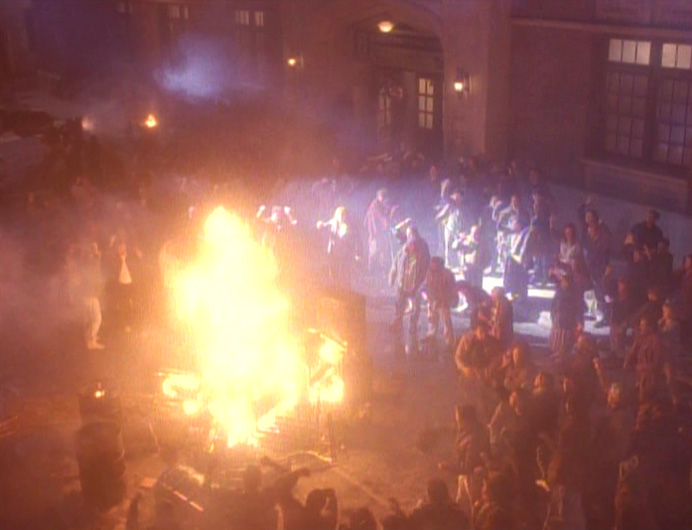
Sometimes, a show about our future can seem prophetic. Cellphones and tablets litter our homes the way Kirk and Janeway carried communicators and PADDs. Headlines about outlawing sleeping in cars invoke an episode about homelessness and blight, riots and rights, seeing the true human cost of gentrification in Deep Space Nine’s “Past Tense”.
But why should we care that Star Trek takes us on a voyage into an optimistic future?
As Gene Roddenberry wrote in the second Star Trek pilot “Where No Man Has Gone Before”, “Morals are for men, not gods.” Star Trek – headed by Alex Kurtzman, through a triumphant Michael Burnham – also made the point that morality is the key to tempering those “basest instincts” of humanity. J.J. Abrams’ tenure told us, “Our first instinct is to seek revenge… but that’s not who we are….”
Star Trek’s optimistic vision for humanity, seeking to better ourselves and boldly go to the stars, is meant to guide and teach us how to be in times to come. It was born from the pain of the past and the fear of the future. It was meant to inspire us in times of trial – trials and tribble-ations that weigh on us just as much today as sixty years ago. And I can think of no greater use of the medium. After all, the trial never ends.
Happy Anniversary, Star Trek! May the “Trek for Peace” continue.
