Greg Cox on Lost to Eternity

Admiral, there be whales here! Not quite the kind of whales you’re probably thinking of, but a whale of a time, threefold. You see, Greg Cox’s ambitious new Star Trek novel, Lost to Eternity, alternates between three time periods: a storyline set in 2024, with a true crime podcaster investigating the disappearance of Star Trek IV: The Voyage Home’s Gillian Taylor; an adventure during the Enterprise’s five-year mission from Star Trek: The Original Series; and a Saavik-heavy storyline that also involves diplomacy, Klingons, Romulans, and the Enterprise-A shortly before Star Trek VI: The Undiscovered Country. About the latter era, Cox notes, “That’s about the only time you can insert an original-movie-era novel.” I recently enjoyed interviewing the author on a deep-dive discussion about his new book.
How did this novel come about?
Well, it all started because, honestly, my wife and I were listening to lots of true crime podcasts. Because these are always about cold cases and missing people and murders and things, at some point, it occurred to me, Gee, what if a modern day true crime podcaster decided to look into the mysterious disappearance of a certain marine biologist in San Francisco back in 1986? My wife loved that idea. She said, “Oh, you have to do that.” And then it became a matter of sitting down and getting a plot out of that, and from there, because this was after all a Star Trek novel, finding a way to come up with plotlines that involved Kirk, Spock, and, indeed, eventually Saavik.

How long did the novel take to write?
There were delays. I first came up with the idea and wrote the outline back in 2020, right before the pandemic hit. I started out plotting the thing in our neighborhood Starbucks, and then there hit a point where that was not a good idea. I thought, Okay, I’m doing this from home for now, because everything was shutting down. And then, the passage of time and real life got in the way. Eventually the thing worked its way through the system, it got approved, I wrote the book.
By the time I went back and forth on revisions and editorial approvals and things and then wrote the book with other real life stuff getting in the way, here we are in 2024, and the book has finally come out. And ironically a good third of the book takes place in 2024, which was sort of the near future when I first came up with the idea. It’s to my surprise that it turns out to be the year the book came out. I wish I could say I planned that on purpose, but it was kind of semi-planned.
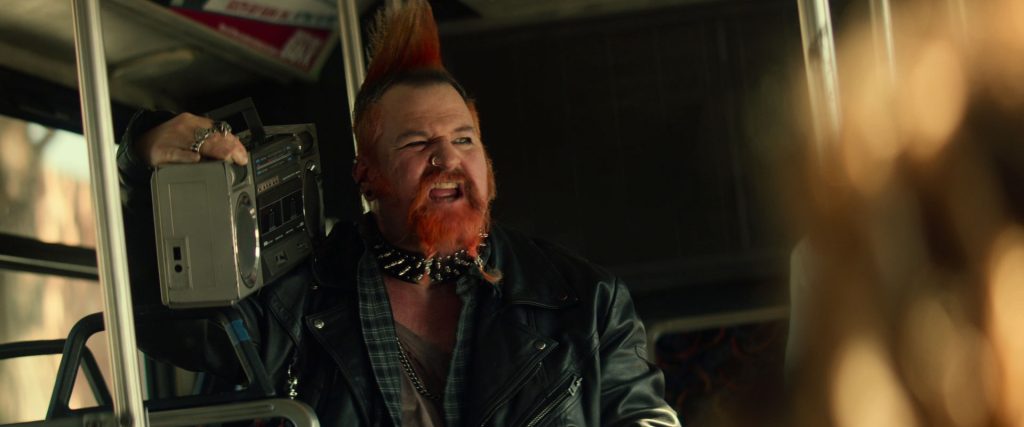
I admit that I set the present-day sequences in 2024 with the hope that, by 2024, everybody wouldn’t still be masking and social distancing because, back in 2020, it was kind of hard to know what the near future was going to be like. I didn’t want things to be dated by having my heroine in 2024 running around wearing masks and doing everything virtually from her apartment. So, I was kind of like, Okay, maybe by 2024, we’ll just assume that life is back to a little bit more normal.
Was your writing of the podcast aspect at all inspired by podcasts that you’ve been on?
No. Like I said, it was more inspired by listening to true crime podcasts. Most of the podcasts I do, it’s me talking about writing. The implication was more things like Serial, the podcast that sort of set off the whole true crime podcast genre. With my heroine, Melinda Silver, I was very much trying to go with that, where somebody digs deep into some old cold case and starts interviewing people. It’s sort of the Star Trek IV – Where Are They Now? book.
Is The Voyage Home your favourite Star Trek film? What do you enjoy about it?
It is my second favorite Star Trek movie, close behind The Wrath of Khan. A lot depends on your mood – you know, do you want something dark and intense and operatic or something light and humorous? I love the fourth movie. It is a feel-good movie that always leaves me grinning. I get caught up in it every time I try to watch it.
It came as a shock to me, as I’ve been talking to people on the Internet about the new book, to realize that movie was nearly forty years ago. I’ve been getting emails and posts on social media because the back cover copy says something like, “Nearly forty years ago, Gillian Taylor disappeared.” I had to keep making that adjustment as I wrote the book to realize that, Oh, wait! Gillian’s old boss at the Cetacean Institute – the one who she ended up slapping in the face – how old would he be now? Oh, Jesus! He’d be in his seventies now. He’s probably not still the boss there. He’s probably retired now. And I had to keep reminding myself of that as I brought in various supporting characters from the fourth movie to realize that, Oh, the little old lady who got the kidney pill probably isn’t still with us anymore.

In fact, I was surprised to find out that the Alameda Naval Base – you remember, “How do we get to Alameda?” – isn’t there anymore. It was closed down decades ago. I did not know this when I started doing research. There was a naval base in Alameda in ’86, but not in 2024.
Were any other films or episodes influential to writing this particular book?
Well, obviously the three movies with Saavik in them, and particularly Star Trek III, because that’s the one that most prominently features her. In the book, Saavik is still having to kind of get over David Marcus’ death and having been taken captive. She’s assigned to a diplomatic mission which involves her traveling on a Klingon ship, which is interesting. So, the fact that Saavik is probably the protagonist of a third of the book – she’s pretty much the protagonist of the movie-era storyline – obviously meant that I took inspiration from Wrath of Khan again and Search for Spock. I would also say that the Saavik storyline has the feel of, say, Star Trek VI, where it’s all political intrigue and largely set aboard ships, with mysteries and attempted assassinations, et cetera.
How did you conduct research for writing this novel?
I found out neat things about San Francisco. I went out and bought a couple of travel guides to San Francisco, just to find out what San Francisco was like and find interesting settings and locations, as Melinda is running around retracing Gillian’s steps back in 1986, because confession: I have never been to San Francisco. Doing the research didn’t just help me avoid making a fool of myself, hopefully, but also gave me ideas.
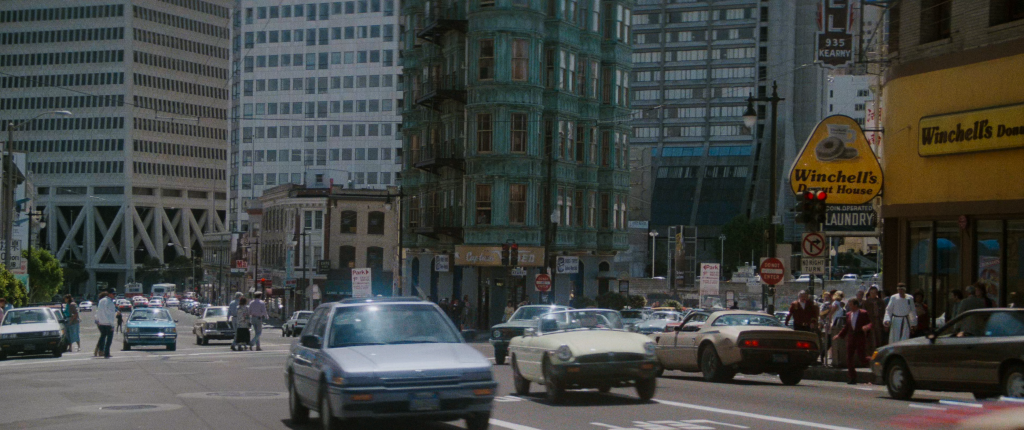
By the way, I wrote the novelization of a Godzilla movie, once, that took place in San Francisco, and again, I did my homework, although someone on Amazon did say, “It is very obvious Greg Cox has never been to San Francisco.” So, I perhaps had that review at the back of my head, thinking, This time, no one’s going to catch me in any errors about San Francisco.
I also leaned very heavily into the fact – following in the tradition of my predecessors Vonda McIntyre, Carolyn Clowes, other Star Trek authors – that Saavik is half-Romulan. So, her having to interact with other Romulans is interesting because, besides the whole fact that Saavik has a history with Klingons, she has a history with Romulans. Her half-Romulan heritage is one of those odd things that’s kind of semi-canon. It’s never actually established on screen, but it was in the original script of The Wrath of Khan, and comic book writers and author writers have been running with it forever. I was even given permission to lean into that whole backstory from the books.
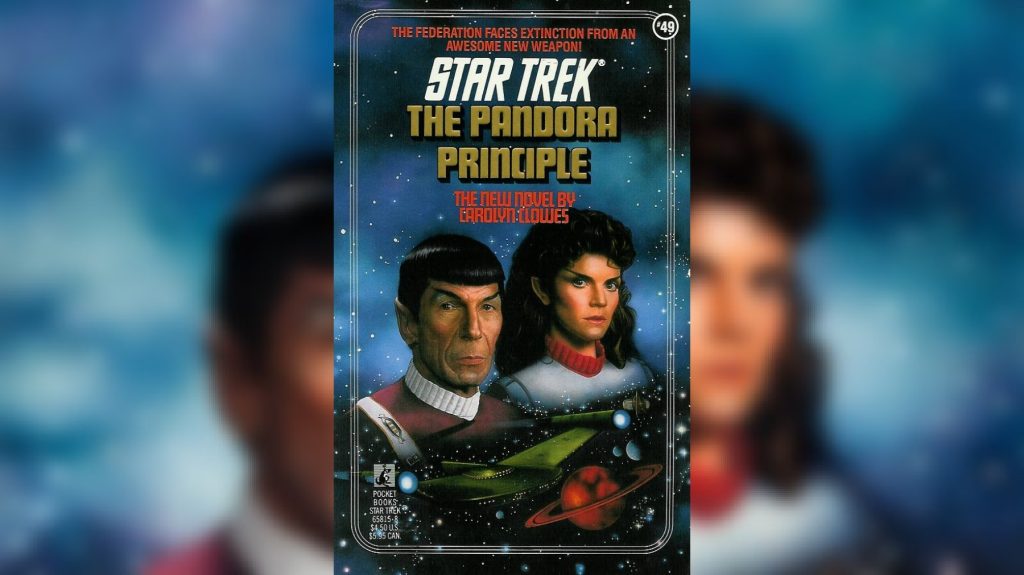
I read, particularly, The Pandora Principle by Carolyn Clowes. It’s one of the seminal Saavik novels that really goes into her backstory. That came out a long time ago. So, I actually did contact CBS and sort of say, “That is an old book, published many years ago. Can I use that?” They replied, “Oh yeah, by all means.” I confess I had never actually read The Pandora Principle before I started working on this book, until I started reading up on Saavik and realized, Oh, this appears to be the definitive Saavik novel that goes the most into her backstory. It gave me an excuse to finally read The Pandora Principle. So, I went and I read it, and it’s a very good book. And Pandora Principle, more than any of the other Saavik books, is the book that informed how I wrote Saavik in this book, on top of looking at how she was portrayed by Kirstie Alley and Robin Curtis in the movies.
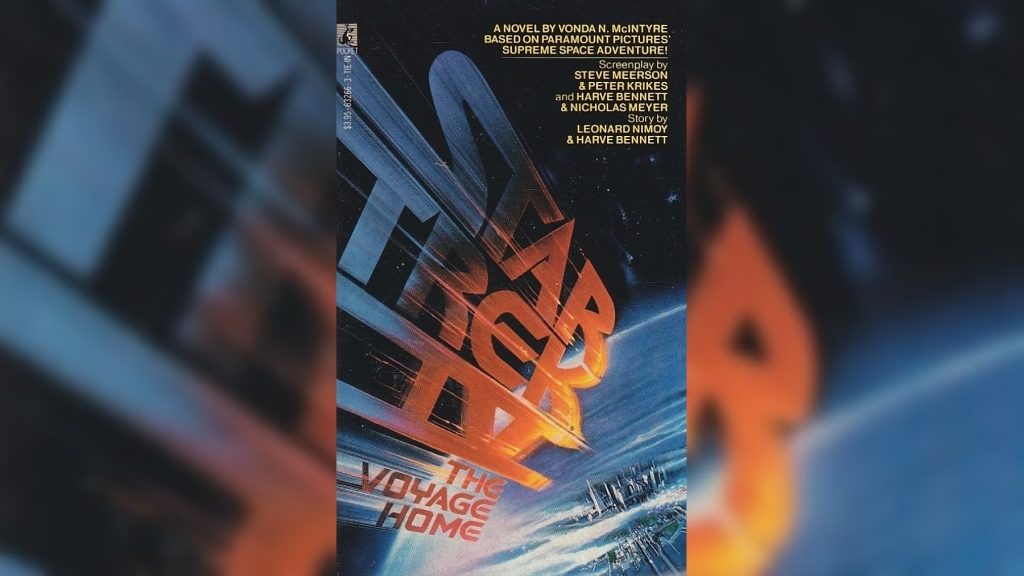
When I was researching this book, I also went back and reread Vonda McIntyre’s novelization for Star Trek IV, and I lifted stuff from it. Vonda fleshed out that movie to a great degree. She actually came up with names and backstories for a lot of the bit characters in that movie, so I did not reinvent the wheel. Take the two garbage men who kind of see the Klingon Bird-of-Prey land in the park. I think they have about two lines of dialogue, dumping stuff into a dumpster, and suddenly there’s this weird noise, there’s this weird depression in the earth. Vonda gave them names, personalities, backstories. Fine. That gave me stuff I could work with. I lifted hers, and in fact Vonda was one of my early creative writing teachers eventually too, so of course I’m going to do a homage to Vonda. She established that one of the garbage men’s names was ‘Javier’, and he was an aspiring writer. Well, guess what? His name is ‘Javier’, and he’s an aspiring writer. He’s forty years older now, in my book, but yeah, I stand on the shoulders of giants.
Talking about other novels, I realised that you previously wrote another book that used ‘eternity’ in the title, which was Assignment: Eternity. Were there any concerns about the possibility that the new book might be mistaken for that one?
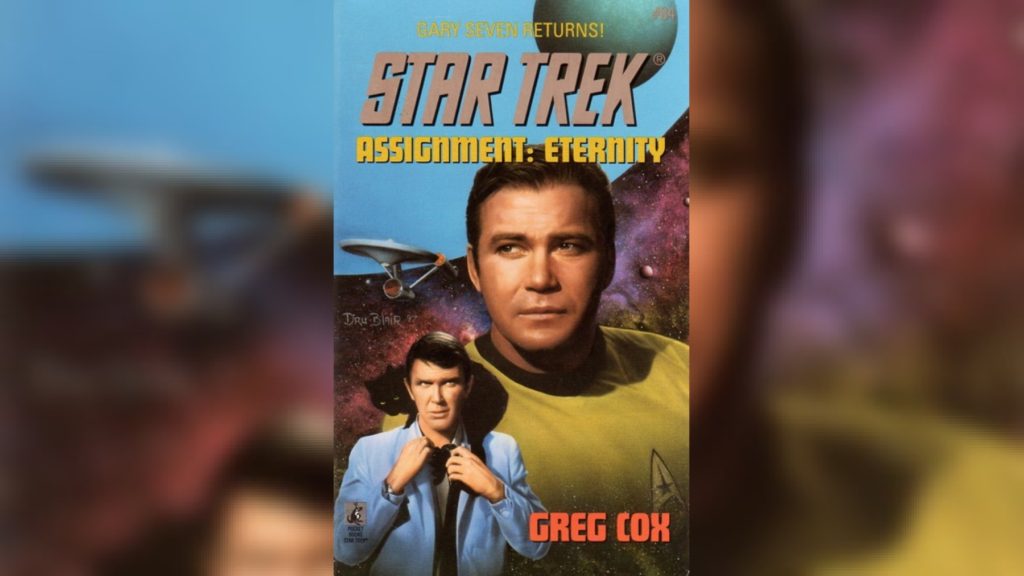
You’re the first person to spot that. That did not come up. At the risk of belaboring my age here, Assignment: Eternity was my fourth Star Trek novel. This is my nineteenth Star Trek novel, I think, not counting miscellaneous novellas, short stories, blah blah blah. That was thirty years and fifteen books ago, so I didn’t even think of that, and apparently it didn’t occur to anybody at Pocket Books either, because that was a long time ago.
I will divulge now that Lost to Eternity was not the original title. I had to change the title because, in fact, it turned out my original title, which I thought was quite nice… There was another big high-profile science fiction novel coming out this summer by the same name, so somebody scooped me during the four-year development process of this book. I’m not complaining; that’s just how it works, and you throw in a pandemic in the middle of that. By the time we got it approved and outlined and edited and everything, somebody else dived in, stole my first title, they announced their book before we announced our book, and it was sort of, “Can we still use my title?” Pocket Books reasonably asked me to hastily come up with a new title. ‘Lost to Eternity’ was the one I came up with, which I quite like.
Can you say what the original title was?
Yeah, it was called ‘Immortal Longings’, and it’s a Shakespearean quote from Antony and Cleopatra. I was doing the Star Trek thing of the high-brow literary quote, but the problem with doing famous Shakespearean quotes is, of course, they’re out there, so I do not begrudge the other author also going for that. That title has been out there since the Elizabethan era! So, I wouldn’t be surprised if neither of us are the first people to use it. If you start diving in quotes from Shakespeare or the Bible or Greek mythology, you take your chances; you’re probably not the first person to use ‘Eye for an Eye’ as a title or ‘To Be or Not to Be’.
The Wrath of Khan was originally going to be ‘The Vengeance of Khan’, so yeah, titles change. This is not unusual. Many of my Star Trek novels had different titles and went through a couple of titles before being published.
How did you tackle the task of writing the Romulans and Klingons in this novel?
There’s a whole lot of Klingons and Romulans, so I had to figure out ways to differentiate them. I couldn’t write, say, all the Klingons just as bellicose warriors. So, I spent a lot of time coming up with different personalities for them and figuring out, Okay, I’ve got six different Klingons, or, I’ve got six different Romulans. They can’t all just be generic and look the same. The Klingons can’t all have names that start with “K”. Okay, this one is sly and kind of sarcastic; this guy is thinking boisterous and drinks his blood wine a little too much. And with the Romulans, some of them are dignified, some of them are a little sneaky, some of them are more sultry than others. By the end, when I was making a list of the characters, I was like, Oh my God, there’s a lot of characters in this book.
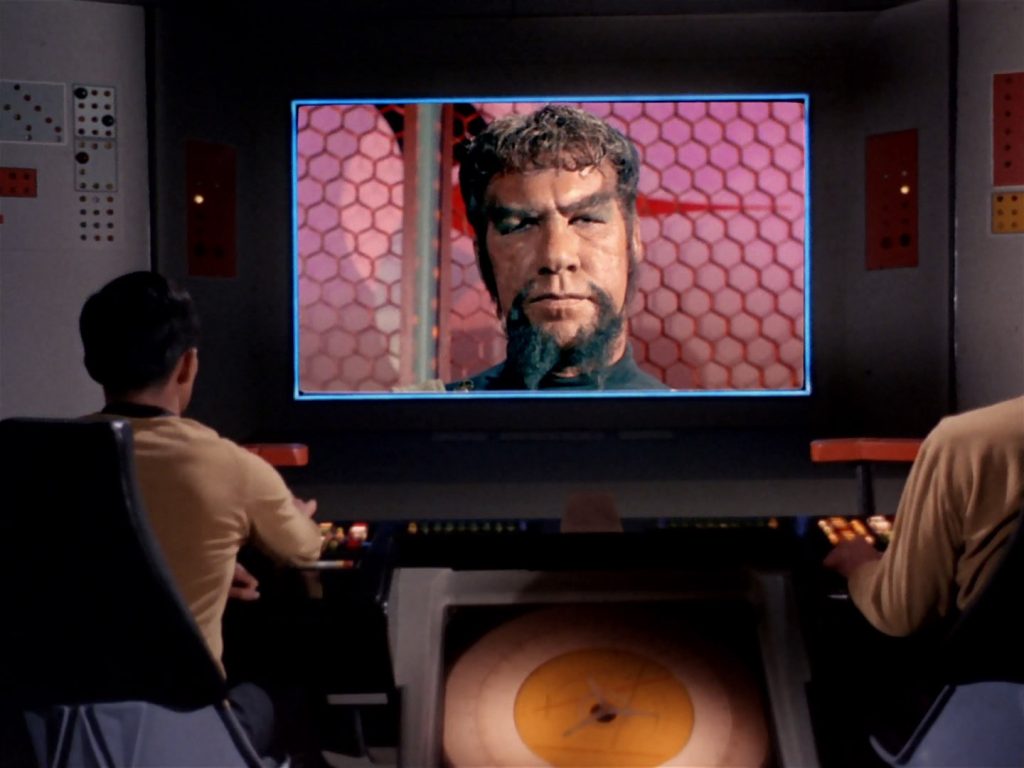
I was looking for Klingons I could use, as I had a whole lot of Klingons and a lot of the big Klingon commanders have all been used. I brought back the guy from “Elaan of Troyius”. He’s not one of the famous Klingons, like Kang or Kor or anything, but I was looking for a Klingon that had been underexplored in the novels, and I remembered him. In “Elaan of Troyius”, he’s not the main plotline, because the main plotline is Kirk and Elaan, but there’s a nasty Klingon commander who (“Surrender or die!”) shows up. In my book, he’s still holding a grudge! Kirk beat him and sent him running, back in “Elaan of Troyius”, and now it’s a year or two later.
I will give a reveal here. There is also a sneaky Klingon intelligence agent in the TOS plotline. In my head, she is played by Sarah Douglas, who played many science fiction villainesses back in the ’70s and ’80s. She was Ursa in the Christopher Reeve Superman movies. She was the evil queen in Conan the Destroyer. She was, I think, on V. She was the sort of, you know, sultry, evil sci-fi femme fatale for a generation.
How did you approach capturing the essence of the Star Trek universe in your writing, including its philosophy and vision of the future?
Well, you always want – when you’re writing Star Trek – to channel your inner idealist, your inner optimist, while still keeping one foot rooted in the harsher realities of life out on the final frontier or indeed in 2024. There are going to be moments where our heroes are going to be in difficult situations and they’re going to be motivated to stand for the ideals of the Federation. In the Saavik plotline, Saavik – despite her issues with the Klingons – is going to try to rise above that. Indeed, Kirk has an issue because, again, we are only a few years after the death of David Marcus here.
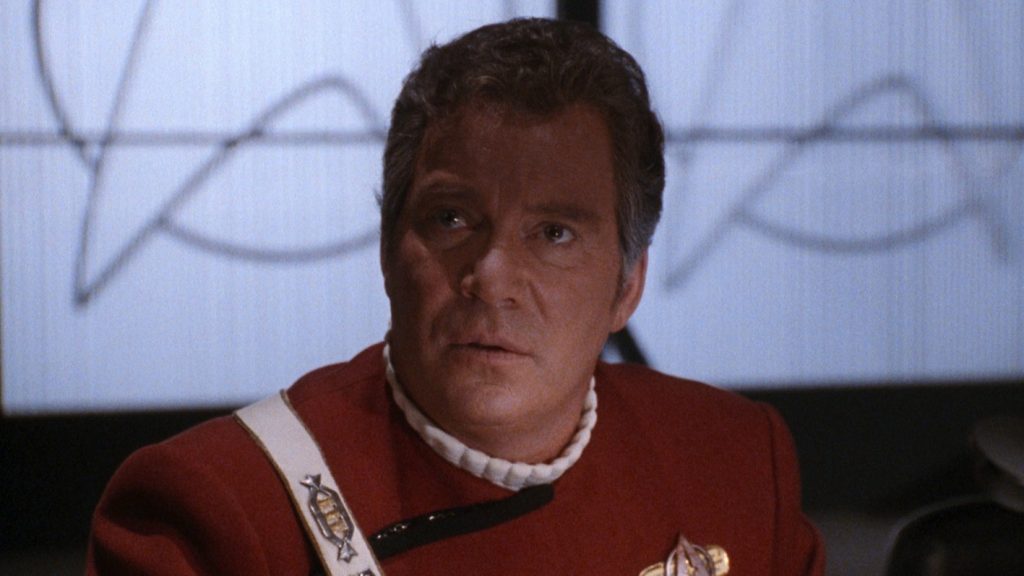
One thing I had to finesse is that the movie-era plotline takes place sometime shortly before Star Trek VI. So, as we know, Kirk still has issues about, “The Klingons killed my boy. I’ll never forgive them.” I had to be a little careful because I couldn’t have this be the book where he decides that, Oh, I’m over it, the Klingons are fine, because – as we know – there’s still going to be some issues by the time we get to the sixth movie.
You mentioned, near the start of this interview, that between films five and six is basically the only gap between the films that you felt you could set the book in. Is there a reason why you chose not to set it between The Motion Picture and The Wrath of Khan or between The Voyage Home and The Final Frontier?
Well, there’s not a lot of gap between Voyage Home and The Final Frontier. I mean, I suppose conceivably you could squeeze something in there, but Final Frontier kind of begins with the, Hi. Here’s our new ship. We’re sort of breaking it in. I’m not sure they literally, explicitly say this is the first time they’ve gone out on the Enterprise-A, but there’s a tone of, Well, geez, we’re not really familiar with this new ship. Scotty’s walking into, you know, low-hanging doorways! So, they’re sure acting like none of them are very familiar with the Enterprise-A yet. I’m not sure exactly the timing it’s in, but it seems to pick up not long after Voyage Home, whereas, like I said, it just seemed easier to sort of set a gap between Star Trek V and Star Trek VI. Between those two films, they’ve somehow gone their own separate ways.
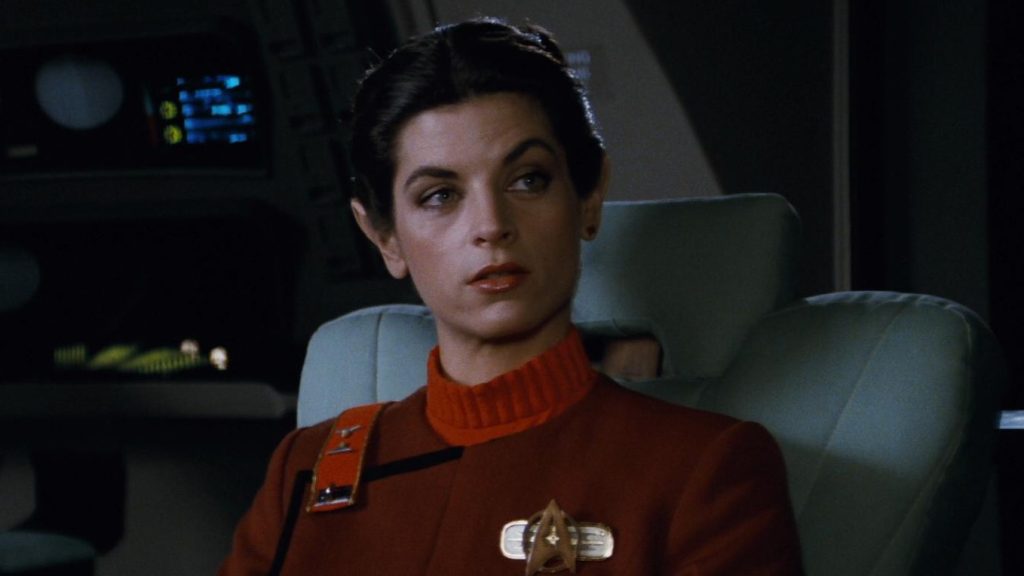
I guess you can stick books in between The Motion Picture and Wrath of Khan too, but then you can’t use Saavik. I wanted to bring in Saavik, in part – like I said – just to make it clear that this is a movie-era storyline.
It is a little hard, I suppose, to stick something in between the first movie and the second movie because you have this whole idea that Kirk is not on the ship. Both The Motion Picture and Wrath of Khan do the shtick where Kirk is an admiral and takes command in an emergency. So, I mean, was there another incident between those two movies where he also had to come in and take over in an emergency?!
And my good friend and colleague Christopher Bennett has been kind of busy fleshing out that period. There’s a sense of, Oh, well, that’s Christopher’s turf, the post-TMP era, so I’ll leave that alone.
Plus, as I mentioned, my favorite movies are the Nicholas Meyer movies: The Wrath of Khan, The Voyage Home, The Undiscovered Country. So, if I’m going to do a movie-era story, I’m going to go into that area. I am less inspired to go into the pre-Wrath of Khan era because Wrath of Khan is my favorite movie.
In which order did you write the book’s different time periods?
I wrote each of the three storylines separately, just the idea being I wanted to keep the momentum going. I didn’t want to have to mentally shift gears every time I started a new chapter. So, I wrote like, Okay, for two weeks I’m going to write the Saavik plot, for two weeks I’m going to write the Melinda plot, for two weeks I’m going to write the TOS plot. This meant that, at the end, I had these three books, as it were.
I had the idea to alternate the time periods, so you get one chapter in 2024, one chapter in the five-year mission, one in the movie era. If nothing else, it meant that we got to the more Star Trek-ish stuff – Kirk, Spock, the Enterprise – much earlier in the book, just to avoid some readers getting impatient waiting for the actual TOS stuff to start. Plus, I’ve been using the same basic structure – alternating between the A, B, and C plots – for my last few books. The only difference is, this time, the three different plots are separated in time, not space, as opposed to, say, my last two books, where the three plots all take place at different locations, on different planets or space stations.
What would you say was the most challenging part of writing the book?
Possibly it was keeping the three storylines straight in my brain and interweaving them. I wrote down every chapter and would have it on index cards and shuffled them. There was much diagramming and index cards and charts to make sure that the three storylines all were sort of flowing at the same pace, so that I didn’t accidentally give away a spoiler in one storyline for the other one. Invariably this required some nipping and tucking to make it all work.
Originally, I’ve got a nice pattern going – ABC: A plot; B plot; C plot. Eventually I hit a point where I realize, Okay, I have to stop the C plot because it’s giving away spoilers for the A plot. So, there comes a point where suddenly we fade away from the C plot, and then by the time we get to the end of the book, we’ve pretty much wrapped up the other two. And I think the last four or five chapters are all the C plot because, as the plotlines start to converge, I can’t actually throw in a chapter from the end of that plot yet, because that will give away the storyline, so the ABC pattern sort of breaks down about two thirds of the way through the book. Hopefully all three of them converge in a logical manner, in what are hopefully unexpected ways.
That’s the challenge of interweaving them and the sort of crossword puzzle grid effect of having three different books, basically, and interweaving them in a way that made sense, because that’s not the order in which I wrote them. Even though I had an outline all laid out, interweaving them was the challenge.
Aside from that, I can’t remember any major plotting changes with this book. There were no major rewrites.
When you were writing this novel, what were a few of your other aims and challenges?
The TOS plotline involves a pre-warp, barbaric planet in the Neutral Zone where, of course, Prime Directive concerns kick in. My idea for the planet in this particular storyline was, What if Kirk and crew ended up on one of these honestly barbaric space opera planets out of Flash Gordon or John Carter of Mars? There are dangerous beasts, there are warring tribes. They end up in a gladiatorial combat in an arena. This is me indulging my interest in a ‘Star Trek meets old-fashioned pulp science fiction’ storyline. That sort of differentiates the idea, which again is the sort of stuff that goes through your brain. If the first storyline is basically a true crime storyline and the movie-era story is very political, in order to get some action into it and some of the more swashbuckling feel of TOS where, you know, Kirk gets his shirt ripped, there’s the action-packed, old-fashioned TOS storyline, leaning into the fun, comic-booky, action-packed stuff.
One of my other goals – this is all about writing – was trying to make sure that, at any given time, the reader knew which of the three storylines they were in, so I labeled all the chapters with dates. I wanted to make it easy and user friendly, so you don’t have to do the math. It’s also maybe easy for a reader just to skim over the little boldface date at the top of the chapter.
I wanted, anytime you open a chapter, you know what storyline you’re in. That’s one reason why I emphasize Saavik, because – even though there are two plots involving Kirk, Spock, and the Enterprise – if you pick up a chapter and your viewpoint character is Saavik, you instantly know you’re not in TOS.
Furthermore, the Saavik plotline mostly takes place aboard ships – aboard the Romulan ship, aboard the Klingon ship, aboard the Enterprise – so it’s all shipboard corridors, sickbays, transporter rooms, whereas the TOS storyline is largely down on a planet. So, if Kirk is riding a weird, exotic alien horse across some desolate landscape and being attacked by strange alien lifeforms, you know instantly this isn’t the political storyline, and obviously, he’s not taking a cab in San Francisco. That was one of the things I was thinking of, just as I wanted to differentiate all the Klingons. Since it is kind of a weird book that goes back and forth between three different plotlines, I was very conscious that – even as one book – each of the three different storylines should have a slightly different tone and you should be able to instantly tell which one you’re in.
What sort of input, if any, did your editor, publisher and/or CBS have on Lost to Eternity?
Honestly, it went very smoothly through the production process. I don’t recall any big changes requested by Simon & Schuster or CBS.
Given that the book was written in chronological order before it was restructured, what was your initial opinion of how the structure ultimately turned out?
I was amused to find out there’s one character whose first appearance in the book ends up coming in because I’m alternating plotlines. I realized he first appears in one of the other storylines way before I actually introduced him in his first appearance elsewhere, so that was interesting.
I also realized at the end that, in a weird way, this is a different book than the one I wrote. There was a moment of trepidation because, like I said, I had the plot chronologically in my head. That is not how the reader was going to read it, and they’re going to have different reactions.
Did you have a hand in designing the cover?
Not at all, though I will say I love this cover. It is gorgeous. Pocket Books run the covers by me, but that’s their department. They have an art department, and CBS is involved. They are very nice. If I have any issues, I will say something. I have that option. In this case, I loved it.
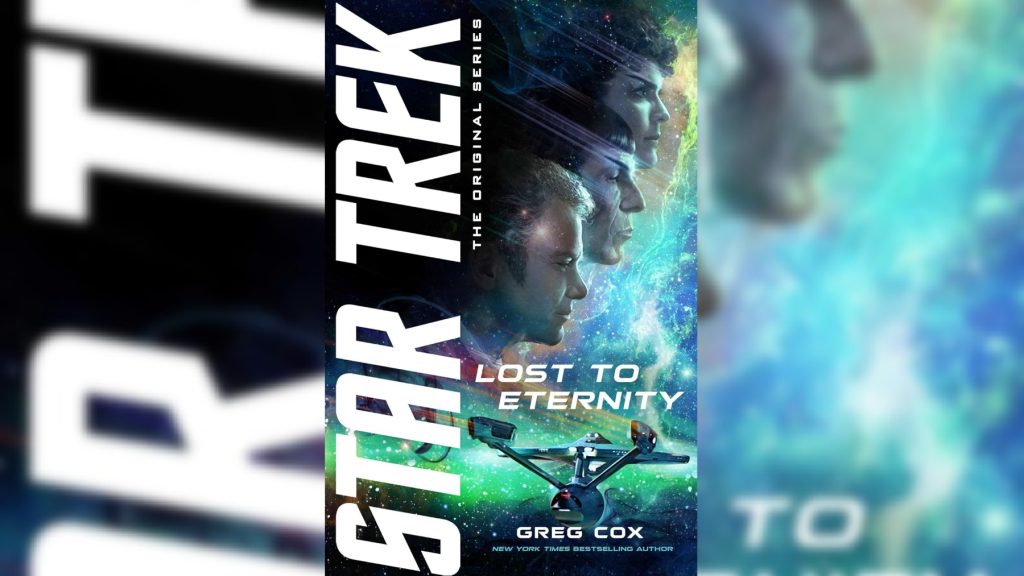
It’s a tricky book because, like I said, there are three different storylines, so there are a lot of different ways they could have gone with it. This cover leans very heavily into the movie era, but that’s fine. I can imagine a cover which would be an unholy mess if they’d said, “Well, we need to get the whales from the movie, and we need to get something from the TOS storyline.” That would just be too many cooks. So, fine. With this, they’re selling the movie era here, and that works for me better than trying to throw in everything in the kitchen sink from this very complicated book.
What has fan response to the novel been like?
When this book first was announced and the cover was dropped, I was very pleased that people were very excited to see that Saavik was back, because there’s not a whole lot of novels about Saavik. There are some, but she’s underutilized perhaps, so I was actually pleased to see that that was what seemed to be fandom’s response on this cover drop, was, “Oh my God, a Saavik novel!”
Because the reader is going to be reading the chapters in a different order than I wrote them, I’m sort of curious to see people’s responses. They’re starting to show up, so I’ve been online compulsively reading people’s comments. I’ve seen a few reviews already from people who liked the book but said that it was a little complicated and confusing to make sure of all the storylines.
I was reading a post by someone on a Trekkie bulletin board this morning who remarked kindly about the fact that we get to see more of Saavik’s emotional reaction in the wake of David Marcus’ death and how she copes and – unlike, say, Valeris – actually manages to rise to the occasion and does not let any resentment of the Klingons compromise her mission.
And in fact, I will brag. I had a cool moment recently. I just got back, days ago, from a Star Trek convention where I actually met, for the first time, Robin Curtis, who played Saavik in the third and fourth movies. I was all fanboy, and I gave her a copy of the book. She did not know that she was on the cover of a brand new book. She seemed genuinely pleased to find out that she was. I gave her a copy, she signed one of mine, and it was a cool, nerdy moment to get to sort of geek out with Saavik herself. In fact, I joked it was amazing that I arranged to have Robin Curtis beamed down into a convention in my own hometown the very week my book was published, but that was just a sheer wild coincidence. I sure jumped on that and took full advantage of it.
As an author, what do you hope readers will take away from your novel?
That reading is fun! You know, I hope people will enjoy it, that it will help them get through a long train ride or if they’re having a difficult, long, hard day. And I hope it will bring some new insights and help flesh out the characters and provoke a nostalgic glow as they remember the whale movie. I hope that the TOS storyline feels like good old-fashioned classic TOS and maybe get some new insights into Saavik, who we haven’t really explored much in a book.
Thank you for this interview, Greg.
It’s fun. Thank you. Like I said, I was working on this book on and off for four years, so it is so great to finally be able to talk about it and share it with fans and readers.
Lost to Eternity is available from all good bookstores. A short story called Homecoming, which Cox has written about the changeover of Enterprise-A helmsman from Sulu to Saavik prior to the movie-era events of Lost to Eternity, will be published in issue 12 of Star Trek: Explorer magazine.

Editor of WarpFactorTrek, Dan is an avid Star Trek fan who lives in Aberdeen, Scotland. Dan has loved Star Trek ever since discovering it in his childhood. He worked as an administrator, for six years, on the encyclopedic Star Trek website Memory Alpha, which involved studying the making of the various series and films. He has also written for the official Star Trek magazine, Star Trek Explorer; has qualified from a Star Trek course taught at Glasgow Clyde College; and coordinated the SubSpace Chatter (formerly The Scotch Trekker) YouTube channel, which regularly featured live interviews with the cast and crew of Star Trek.