Diving Deep into “Past Tense” with Robert Hewitt Wolfe

Let’s get numerical. The Deep Space Nine two-parter “Past Tense” – the eleventh and twelfth episodes of DS9’s third season – involves three main characters traveling back in time to our current year, 2024. Are you with me so far? The writing of the two-parter is credited to three writers: Robert Hewitt Wolfe, Ira Steven Behr, and (for part two) René Echevarria. I recently spoke with Wolfe to discuss how “Past Tense” corresponds to our modern era and the Star Trek chronology.
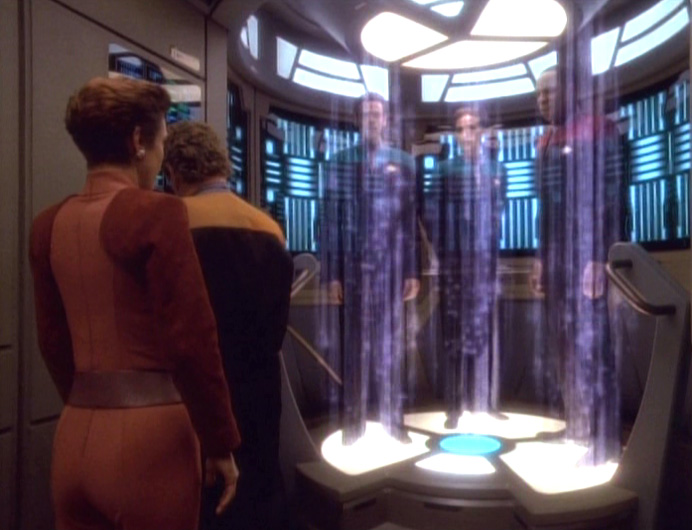
Why was the Defiant’s transporter chosen as the means of time travel?
We didn’t want them to have any resources, and that was just the best way to get them to a planet – to Earth, specifically – without any ship or anything to depend on. And it also meant that we could have people on the Defiant seeing the timeline change. That was basically it, and I don’t know that anyone had ever done that as a way of time travel before, so it was different than the ways we’d done it.
How would you say the real 2024 measures up to how you imagined it when you wrote “Past Tense”?
The truth of the matter is I didn’t really imagine a full-fledged 2024. I imagined it through the eyes of those three characters. And so, there’s a little bit of a Barnum effect – the principle that makes fortune-telling work, which is, if you throw out enough details, people grab onto the ones that end up being right and ignore the ones where you’re wrong.
I mean, I definitely thought that there was a danger that the income gap and the wealth gap would continue to increase. I was a little worried at the time that we were getting more oligarchical and the rich were getting richer and more powerful, and that was not great, I did not think. That’s sort of happened, unfortunately. It was almost a problem at the time, so it wasn’t really a big stretch. I think I probably underestimated the polarization. I think Ira, René, and I underestimated that, and the way that different sides now can have their own truths.
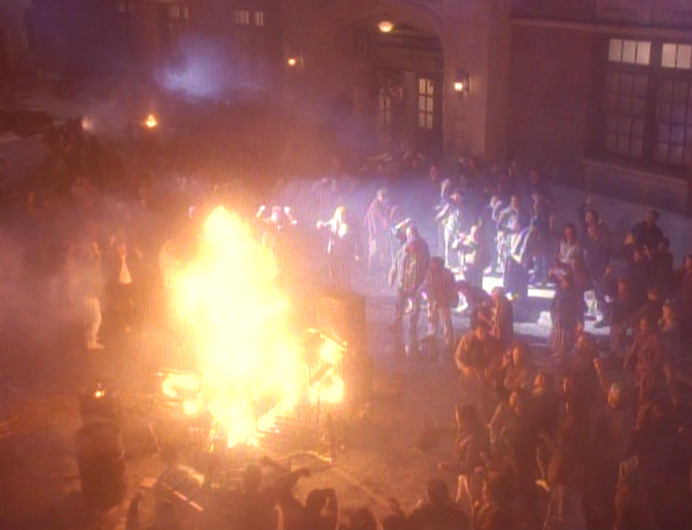
We sort of didn’t really understand that – as a consequence to the Internet and the proliferation of channels and stuff like that – that people would get to choose their own facts. We sort of thought there would still be an objective truth that people could agree on. So, I think today, if the Bell Riots really happened, I don’t know that it would have the same effect, because I think the people who didn’t want to be moved by them would interpret it completely differently than the people who were willing to be moved by them, and that’s sad, but that’s one place where we got it wrong.
Is there a reason 2024 was picked as the setting?
It was thirty years from the dates we wrote it. That was it; there was nothing special about it. We wanted it to be far enough away that it would be valid for a long time as something that could still happen – you know, not break the fourth wall. I think we also kind of wanted it to be within our lifetimes, so if we made it to 2024, we could have these conversations.
Why do the citizens of 2024 have lingo all their own?
Everybody has lingo all their own! We just created that to try to create a feeling, in 1994, that we were in a different time. Obviously, there’s completely different lingo/slang in 2024 than there was in 1995 when the show aired or in 1994 when we wrote it. But we weren’t going to be able to guess what people were saying or what their slang was, so we just made up some stuff.
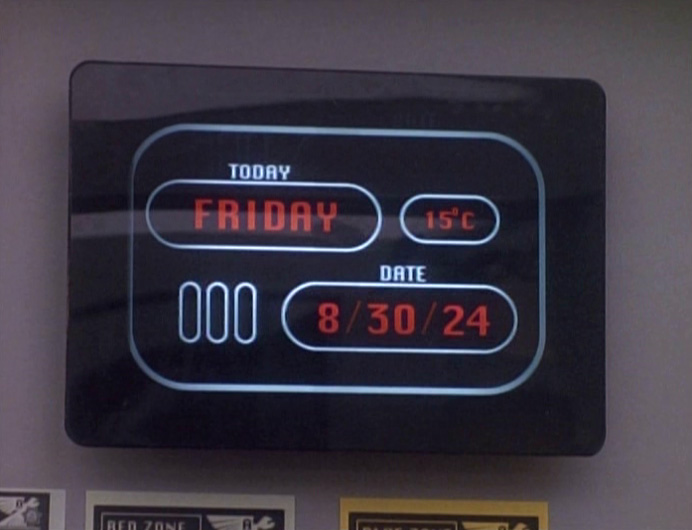
Is there a reason why named days – for example, Tuesday and Friday – are not mentioned in the two-parter’s dialogue?
We didn’t want to do the math, basically. It’s lame to say it, but when we were writing the episode, we didn’t have the tools at our disposal to easily figure that out, and so we didn’t bother with days of the week. And then production figured them out, so God bless them.
Is there a reason why neither the Eugenics Wars nor World War III are mentioned in the two-parter?
Well, Eugenics Wars were supposed to be happening in ’99 or something like that, so we knew that was going to be a miss. We also picked a date that was before World War III on purpose because we didn’t want to do an episode about World War III. We weren’t interested in that, and we weren’t really interested in doing an episode about the Eugenics Wars.
We wanted to do an episode about our own little point in time, so we chose a year in Star Trek “history” where nothing had happened before, so we didn’t have to deal with anything… as far as we could. I mean, I think we might have messed up there somewhere. But anyway, we were trying to have our little tale exist on its own without having to worry about other things in the continuity.
Why is it that Romulans are active in the changed version of the timeline?
I probably just hadn’t done a lot of Romulans, so we decided to do that. We wanted it to be different than what we were usually dealing with and I think we hadn’t done a lot of stuff with Romulans, so we just said, “Yeah, sure, Romulans.” Sometimes the decisions are not that deep, to be honest.
There are no cars at all in “Past Tense”. Personally, I think – and I know other people do as well – that that does make sense because the setting is fairly confined to areas where you wouldn’t necessarily see cars. But was that a conscious decision?
Right. Two things. Yes, we didn’t need cars, but also we couldn’t afford cars. In other words, we would have had to show what cars looked like in thirty years. We would have almost certainly not done it right. But also, we would have had to pay a crap ton of money. That’s a very expensive thing to do, to take cars and try to modify their frames and make them look different. $10,000 a car, probably even then, and we just didn’t want to spend that money that way, so we just figured that San Francisco had banned cars from the downtown core and that you would never see cars. It was all pedestrians and public transport, which is why even somebody like Chris Brynner is taking the subway.

The year 2024 continues to be portrayed in “Past Tense, Part II”, whose script is credited to Ira Steven Behr and René Echevarria. Was there anything they did in that episode which either pleased or disappointed you, regarding how they represented 2024?
We all worked together. The credits aren’t reflective of the work. I mean, René helped us with part one, and we helped René with part two, and we all broke everything together as a group. So, there wasn’t any real disagreements. I mean, everything eventually went through Ira’s final, you know, looks.
So, were you happy with how 2024 was represented in the two-parter?
Honestly, I didn’t really care that much about prognostication. I was happy with the way the story turned out. The representations of 2024 are just in service of the story we wanted to tell. I think the episodes themselves turned out well. I mean, Ira feels like we got a little preachy in places, and I don’t disagree, but I think overall, it’s a pretty strong story.
Great cast, by the way. We really were very, very fortunate to get a terrific guest cast. We generally had pretty good luck on Deep Space Nine, but every once in a while, things didn’t quite hit. But in this episode, I think we just had a really terrific guest cast, and of course our regulars brought it too, so that helped a lot. I think, in general, the episodes hold up pretty well.
It’s been questioned whether “Past Tense” ended up inspiring ”Far Beyond the Stars”. Both had the same working title: “Cold and Distant Stars”.
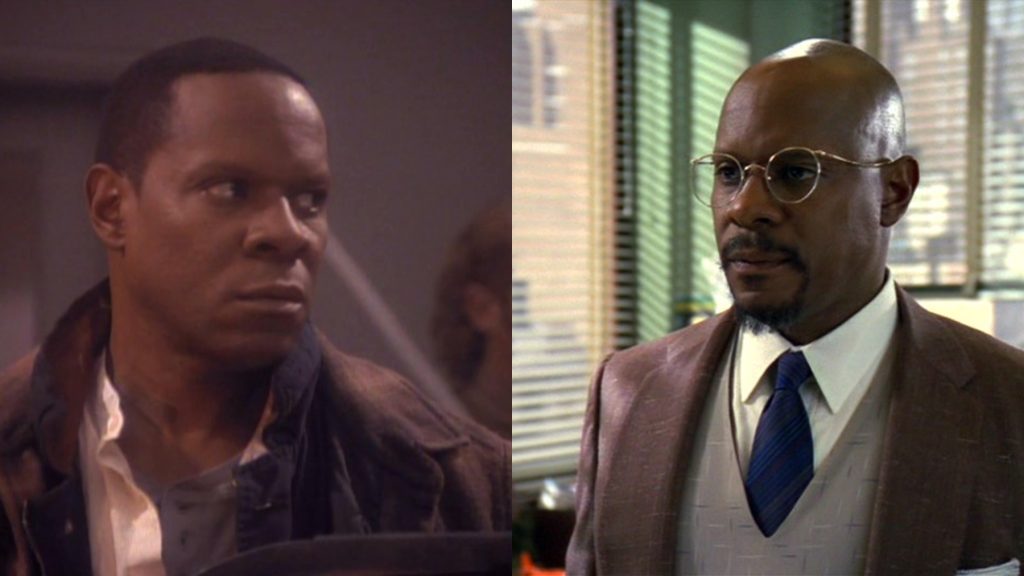
My original pitch for “Past Tense”, which I tried to sell Ira for a while, was much closer to “Far Beyond the Stars”. A freelancer pitched “Far Beyond the Stars”, but I think what he pitched was pretty different. And so, I’m pretty sure that they incorporated elements, here and there, of what I had been pitching for a long time before we landed on the “Past Tense” story, which is why they used the same working title. I was gone at the time that they did “Far Beyond the Stars”, and they actually called me, like, “Can we use your title?” I’m like, “No! It’s my title! I might want to use it someday.” It is a better title anyway, to be honest, for that episode than for what I’d originally pitched.
Some people have also likened your original idea for “Past Tense” to a Voyager two-parter called “Future’s End”, where there was a Captain Braxton from the future who ended up as a homeless guy in Earth’s past.
I watched some Voyager. I don’t think I’ve seen that one. I was working for Star Trek when I came up with the idea, so they own it, but I have no idea.
Look, the other thing is, a lot of times, we would come up with stuff, and then freelancers would come in and pitch different versions of it. Sometimes we would be like, “No, we already have that,” and sometimes like, “Oh, we like your version better. Let’s do it.” So, I don’t really worry too much about that. It’s happened a few times. There’s probably times when we did stuff on Deep Space Nine that they were kicking around on Voyager and we preempted that. It’s just the way it goes. When you’ve got twenty-six episodes a year of Star Trek, there’s just a group-thinky-type thing that happens there.
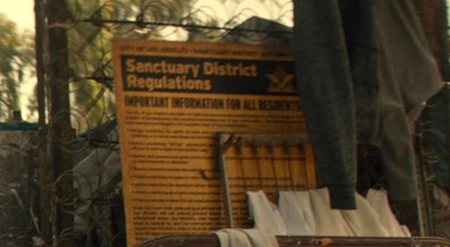
Sanctuary Districts were referenced in the second season of Star Trek: Picard. What do you think about that?
I haven’t seen the second season of Picard. I only saw the first season, so I haven’t gotten to it yet. They didn’t pay me any money, so that’s the only thing I can say about that.
Were you aware the Sanctuary Districts concept is referenced in Picard set dressing?
I was aware it was used and that there’s graffiti about “Recall Chen” or whatever, but I just haven’t gotten around to seeing it. I’m working on a show, and when I’m working on a show, I don’t have a lot of time to watch TV.
Season 2 of the TV series that Wolfe is currently working on, The Irrational, is set to premiere on 8 October 2024. Wolfe has meanwhile encouraged those who would “like to honor Gabriel Bell” to “consider donating to your favorite charity that helps the unhoused and the hungry.”

Editor of WarpFactorTrek, Dan is an avid Star Trek fan who lives in Aberdeen, Scotland. Dan has loved Star Trek ever since discovering it in his childhood. He worked as an administrator, for six years, on the encyclopedic Star Trek website Memory Alpha, which involved studying the making of the various series and films. He has also written for the official Star Trek magazine, Star Trek Explorer; has qualified from a Star Trek course taught at Glasgow Clyde College; and coordinated the SubSpace Chatter (formerly The Scotch Trekker) YouTube channel, which regularly featured live interviews with the cast and crew of Star Trek.