Voyager: “Caretaker” Review
On 16 January 1995, Star Trek: Voyager premiered on television. Coming hot on the heels of The Next Generation and running at the same time as Deep Space Nine, Voyager took some cues from its predecessors. Like DS9, the writers decided to change things up a bit and have Voyager disappear to the other end of the galaxy, where Starfleet is unknown. But how does the show hold up after all these years?
Summary
The USS Voyager, under the command of Captain Kathryn Janeway, is assigned to find a lost Maquis ship that was carrying, among others, B’Elanna Torres, Chakotay, and Tuvok. The latter is undercover to infiltrate the group and report back to Starfleet.
After gathering up some crew, Janeway receives information from pilot and former Tom Paris to head for the Badlands. The ship is thrown clear across to the other side of the galaxy, some 70,000 light years away from home. Welcome to the Delta Quadrant!
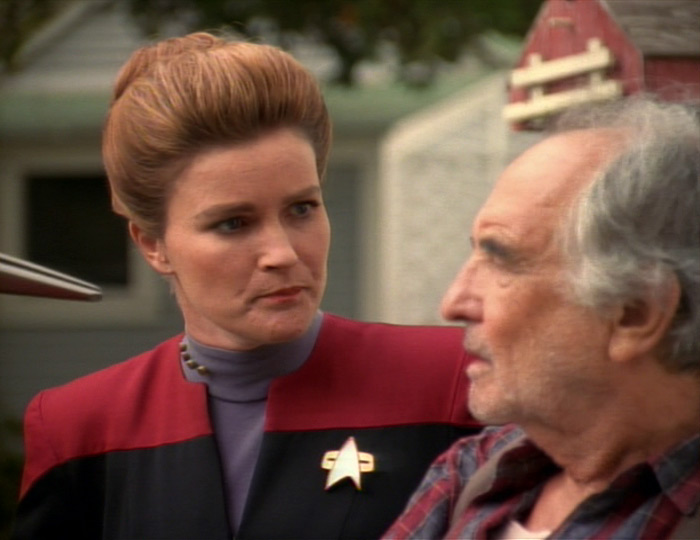
Upon encountering a space array that is shooting energy pulses into a nearby solar system, the crew is suddenly whisked away to what appears to be a farm in the Southern US, except it turns out to be a holographic simulation. In reality, they are being experimented on aboard the array but are then transported back to Voyager, with Tuvok and Chakotay in tow. However, Torres and Harry Kim are nowhere to be found.
Voyager goes to the planet which the pulses are being transmitted to and discover it to be a barren wasteland. The Kazon are living aboveground, with water scarcity, and the Ocampa are living underground, with plenty of resources being provided to them by the Caretaker. Janeway and Voyager mount a rescue mission and save Kim and Torres.
However, the captain meets the Caretaker. He reveals he is from an ancient race that came to visit that part of the galaxy a millennium ago. The Caretaker accidently caused the barren landscape and attempted to find redemption in protecting the Ocampa. Along the way, he knew he would die and wanted to find a compatible mate so his offspring would take over the position. Since one could not be found, he sets the array on self-destruct mode.
Janeway is faced with a choice. Option one: destroy the array (the self-destruct becomes inoperable) and protect the Ocampa from the Kazon, who want their resources. Option two: leave the array alone, so as to retrieve the information from it on how to get home, but give the Kazon a chance to take the array over. She chooses the former, stranding Voyager far from home.
Analysis
I originally watched the series premiere “Caretaker” about twenty years ago and, before a recent rewatch for the purpose of writing this article, I only remembered very minuscule parts from it. Consequently, this latest viewing felt like a first-time experience. For one who has not watched the series before, doing so now – on its thirtieth anniversary – is exciting, to say the least. I came in knowing tidbits of information about the show from other sources in the franchise, but I’m still pleased to report that I was delighted with what transpires during “Caretaker”. Having Voyager go missing in a distant region of the galaxy was definitely the right move to spice up the franchise that was on its fifth go around. I found myself being engaged (no pun intended) with what was being presented to me and wondered what kind of adventures were in store for the future.
It did not hurt that the first few minutes of this episode throw the viewer into the heart of the action, and I promise that one does not need to be acquainted with the whole Maquis storyline to enjoy the episode. I feel that was a strength of the storytelling. I know the writers were trying to make some sort of connection to DS9 (where the Maquis showed up previously), but they correctly didn’t dwell on it and used it only as a jumping-off point. Besides the quick explanation at the beginning of the episode, I didn’t feel like I needed to go and research more of the context. In fact, I love when I’m watching TV or a movie and I’m not quite a hundred percent sure of what’s going on, because it only adds to the viewing experience.
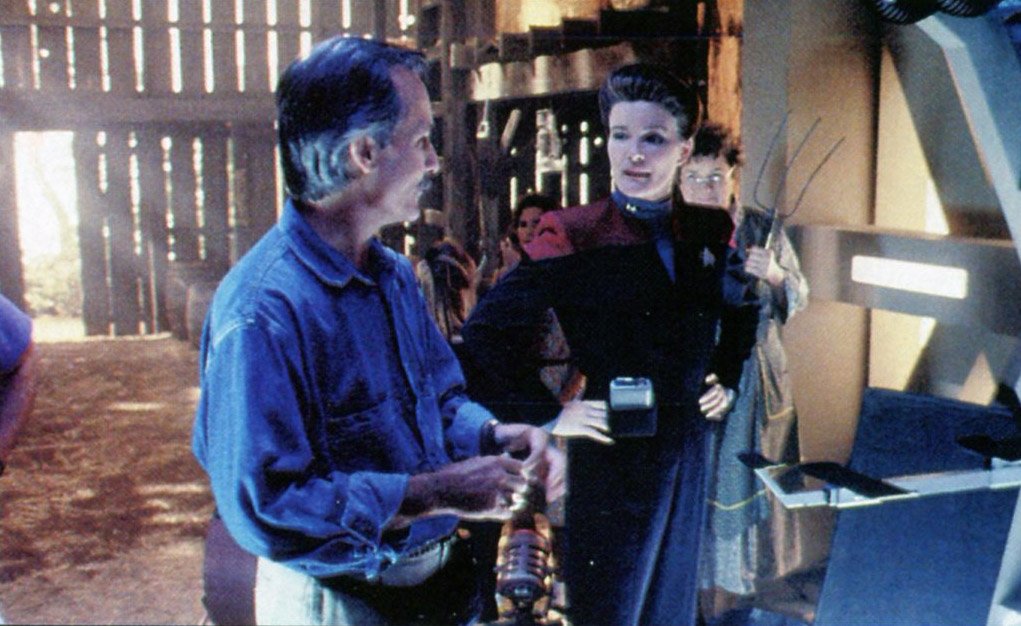
While Star Trek had its first female captain on the big screen with the Saratoga’s captain in Star Trek IV: The Voyage Home, it’s refreshing to go back and watch the first show in the franchise to be led by a female captain. Janeway is introduced as a confident and strong female character. However, what I was moved by was her compassionate side that she shows her partner back home, before Voyager’s disappearance. There is also a lovely little scene between Tuvok and herself that gave me a true sense of how much she truly cares for her crew, even if she has not yet known them for very long.
The episode, for the most part, is well-balanced and unafraid, like other shows, to throw in some moments of humor. One of the biggest laughs happens when everyone leaves sickbay and the Doctor quips, “Doesn’t anyone know how to turn off the program when they leave?”
I was surprised, too, by the level of conflict presented early in the show. Most stories will set up payoffs for down the road. Voyager not only does this but does it well. For example, after Janeway makes the decision to strand the crew in the Delta Quadrant, Torres argumentatively questions it by asking, “Who does she think she is?” Chakotay answers that she is the captain. I love the intense aura of feelings coming from Torres, implying a conflict to come, over such a decision. While the mission is a success to a certain point, the ending of “Caretaker” leaves a lot of questions and conflicts unanswered that will hopefully be examined later in the series.

“Caretaker” attempts to try something new – so as to not get stuck in the same area of space as the other Star Trek shows – and for the most part, it all works. Yes, there are a couple of moments that felt a little stagnated, but I was never bored or found my mind wandering. In fact, the episode kept my attention with its production design, story, wonderful acting (I’m looking at you, Robert Picardo), and finally, the promise of things to come. I’m definitely here for it.

Nicholas discovered writing and has been perfecting his craft for over a decade. He fell in love with Star Trek in his teens and hasn’t left it since. In 2025, Nicholas received a BA in Political Science with a minor in English from UC Berkeley. Currently, he is pursuing his MA in English Literature from SF State University. He is working on a sci-fi novel that he describes as a “road trip in space.” He enjoys reading, writing, and watching TV shows and movies. When Nicholas isn’t working to further his education, he spends time with his wife and dog.